
Washington County Parole and Probation
Parole and probation can both place a Washington County person in the community under rules, yet they begin in different ways. Parole is a conditional release from prison after part of the prison term. It suspends the balance of confinement while the person follows imposed terms. Probation commonly follows a suspended sentence ordered by the court. The Oklahoma Department of Corrections, or ODOC, can supervise either status. Physical presence in Bartlesville therefore does not mean the state case is closed.
The distinction matters when reading a record. A parole entry points back to imprisonment and a release decision. A probation entry points to the judgment and suspended term. Neither means discharge. Only a termination or final discharge record supports the claim that ODOC jurisdiction has ended.
| Point | Parole | Probation |
|---|---|---|
| How it starts | Conditional release after part of a prison term | Court-ordered community supervision, often tied to a suspended sentence |
| Key decision source | PPB action, and gubernatorial action for a violent case | Washington County judgment and sentence |
| Current verification | ODOC status plus assigned parole office | ODOC status plus assigned probation office |
| Proof it ended | Final discharge or termination record | Final discharge or termination record |
- Parole
- Conditional release from prison while the rest of the sentence remains subject to rules.
- Probation
- Community supervision ordered by a court, often as part of a suspended sentence.
- Discharge
- The formal end of ODOC jurisdiction, not merely release from a jail or prison building.
- Absconder
- A person reported as having left supervision without authorization while obligations remain active.
Check Washington County Supervision
Start with the official ODOC offender lookup. It serves people who entered the Oklahoma corrections system through incarceration, parole, probation, GPS, or another ODOC status. It does not cover every person released from the Washington County Correctional Facility. Someone who posted bond, finished a short county sentence, or had a case dismissed may never have an ODOC profile.
ODOC warns that its public material is abbreviated and that its lookup has experienced data-source issues. Match more than a name. Compare the ODOC number, Washington County case, offense, and sentence information where shown. Then check the Washington County court case to understand the judgment and call the listed supervision office for the appropriate public verification route.
- Search the ODOC lookup by full name or a known ODOC number.
- Match identity and the Washington County case instead of relying on a same-name result.
- Read incarceration, parole, probation, GPS, active supervision, and completed jurisdiction as distinct statuses.
- Compare the result with the Washington County court docket or certified judgment.
- Call the Bartlesville office first and ask staff to confirm the assigned reporting office.
- Request a final termination or discharge record when proof that supervision ended is needed.
For the broader county-jail and court verification chain, use the Washington County released-inmate search. It explains why a person can leave the current roster without entering ODOC supervision.
Washington County Supervision Office
The local state-supervision contact is the ODOC Bartlesville Probation and Parole Office. ODOC’s official directory assigns Washington County to that office. It also lists a Stillwater suboffice with multi-county coverage that includes Washington, so geography alone does not establish where a particular person reports. Bartlesville is the first call, followed by confirmation of the assigned office.
ODOC Bartlesville Probation and Parole Office427 Southeast Comanche
Bartlesville, OK 74003
918-336-0866
The ODOC supervision-office directory is the source for this Washington County assignment. Its Bartlesville row is shown in the captured official page below.
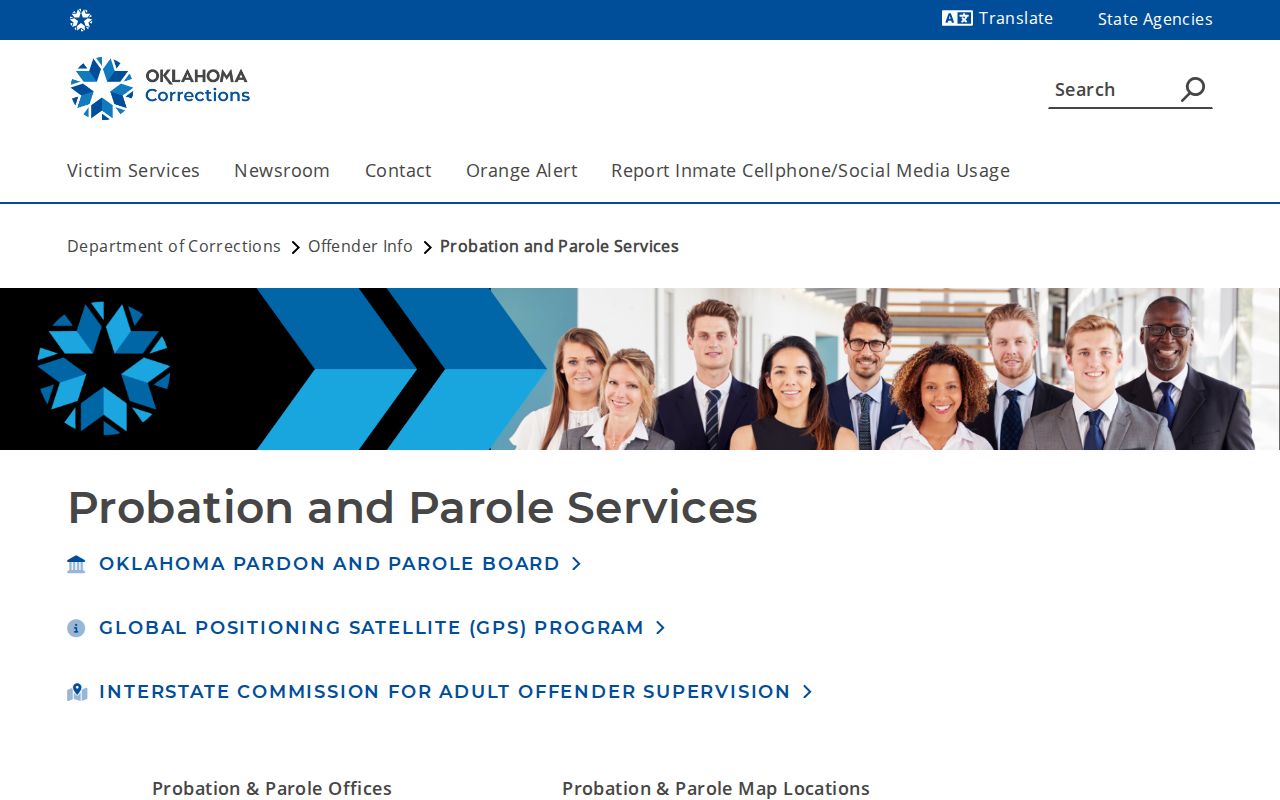
The office listing supplies a real local verification path while still requiring staff to confirm the correct officer or reporting location.
ODOC also publishes statewide operational contacts. The Parole Process Coordinator is 405-425-2605. Interstate Compact questions use 405-425-2603, facility transfers use 405-425-2735, and warrants or retakings use 405-425-2603. These lines serve narrow functions. They do not replace the local office for a routine Washington County status check.
Note: An Interstate Compact transfer can place active supervision in another state even when the conviction arose in Washington County.
Washington County Parole Decisions
The Oklahoma Pardon and Parole Board dockets and results preserve the hearing trail. Its search accepts a docket month and year, ODOC number, last name, and county. Monthly files can show the person’s name, ODOC number, Washington County conviction, case, sentence, parole eligibility date, projected release date, Board action, and conditions. Those fields describe consideration and action, not the final custody event.
Result wording must be read literally. “Parole To Street” is strong evidence of favorable Board action, but ODOC status or an implemented release record should confirm what occurred. “Parole To Detainer or Void” does not mean community release. A “Pass” is not approval, and a denial is not discharge. For nonviolent offenses, the Board can grant parole. For violent offenses, a favorable vote is a recommendation and the Governor makes the final decision. Three favorable votes are required, and results are not final until the meeting adjourns.
The Board publishes a regular monthly calendar through its official meetings page. Meeting details can change, so the live page is the sound source for an agenda, deadline, or remote-access information. Eligibility under 57 O.S. §332.7 is merely the chance to be considered. It is not a promised release or proof of present parole.
Washington County Supervision Conditions
Conditions are case-specific. A public PPB result may list treatment completion, monitoring, or another special term in a favorable case, while the judgment and supervision documents control the full set of requirements. A community placement, GPS status, or parole entry means the person may be outside a prison yet still answer to ODOC. A transfer to another custodian may also end prison placement without creating freedom from all custody.
Potential violations follow agency and court processes. A report, warrant request, retaking, revocation hearing, or court order may change the person’s status. A live public screen may lag those steps. Do not infer a violation solely from a missing profile or old docket entry. Compare the ODOC record, official PPB result, Washington County case, and the assigned office’s public response.
Oklahoma VINE has a narrower role. It reports custody changes from participating data, but the PPB expressly states that VINE does not provide parole notice. Crime victims seeking advance parole-hearing or release-to-parole notice must use the Board’s separate victim-notification program. VINE may also become inactive during an ODOC transfer to a Department of Mental Health facility and resume after return.
Note: Release from physical custody and release from legal supervision are separate events, and each needs its own official record.
Washington County Absconder Status
No Washington County-only ODOC absconder list was verified. ODOC uses statewide fugitive and warrant channels. Its Fugitive Warrants Division lists 405-425-2570 and 405-425-2571, the toll-free hotline 866-363-1119, and warrants@doc.ok.gov. A sheriff “Most Wanted” notice is focused on a warrant. It is not a past-release record, discharge record, or full account of supervision.
State policy adds useful timing but not certainty about a public page. ODOC OP-060212 requires a confirmed escape or absconding movement to reach the computerized offender record no later than the next working day. OP-160901 describes the parole-warrant request and absconder checklist. An approved request normally leads to issuance within three working days after the revocation administrator receives it. Those are internal process rules. They do not promise that all public views update at once.
Most important, absconding is not discharge. The person’s supervision duty remains unresolved, and warrant or revocation action may follow. A prompt status change can be informative, but only a later termination or discharge record proves that ODOC jurisdiction ended.
Property After Washington County Release
The Washington County Correctional Facility permits a person in custody to designate someone to receive stored property, with one key limit: the transaction releases all property except one set of street clothing. That rule helps explain why clothing may remain for a later release or transfer. The county does not publish a post-release pickup deadline, exit desk, remaining-account payout method, or unclaimed-property procedure.
Call the jail at 918-332-4011 for a current operational answer rather than assuming a process. Property release is separate from parole or probation verification. A designee’s receipt of stored items does not establish that custody ended, and it says nothing about whether ODOC supervision began.
For state records, ODOC policy distinguishes durable final records from short-lived planning reports. Closed final records are maintained indefinitely, while temporary monthly current-release-date reports may be purged. A final discharge or disposition request is thus stronger proof than an old projected-date printout.
Washington County Supervision Discharge
Supervision ends through a formal agency or court action, not merely the passage of an estimated date. ODOC’s public status can help distinguish active parole, active probation, and completed jurisdiction. When the label is unclear, request the final disposition from ODOC Closed Records or Discharges at 405-425-2691 or osordischarges@doc.ok.gov. The underlying Washington County judgment may also show the term ordered, but ODOC’s final record is the better source for its own termination action.
A clean verification sequence is simple: identify the person accurately, read the ODOC status, compare the county case, call the assigned office, and obtain the final record when the end date matters. That sequence avoids treating release from the county jail, parole consideration, a favorable vote, or silence from VINE as proof that all supervision has closed.
Note: Completed jurisdiction is materially different from parole, probation, GPS placement, a detainer, or a transfer between custodians.